FOL Fridays: How Repetition Strengthens the Brain

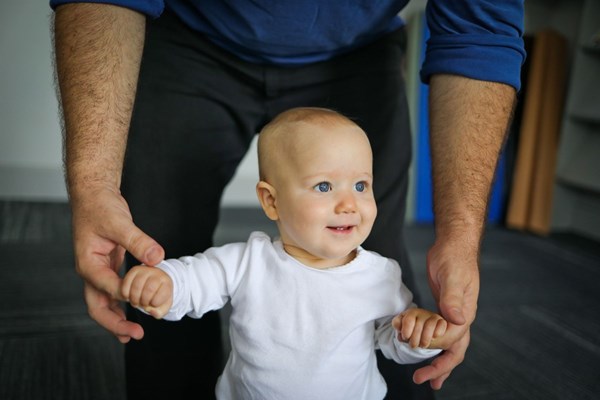
“Repetition continues to be important in the development of language and movement, as it is repeated experiences that reinforce the pathways of the brain.  By two years of age, a toddler’s cerebral cortex contains well over a hundred trillion synapses, which is actually some fifty percent more synapses than she will keep as an adult.  While new synapses form rapidly during this time frame, a ‘pruning’ process is also taking place.  This process strengthens frequently used pathways, while deleting those that are not used.  As pruning continues, it will allow your child to process thoughts and actions more quickly and efficiently” (zerotothree.org. 1998-2001)

Tips for parents:

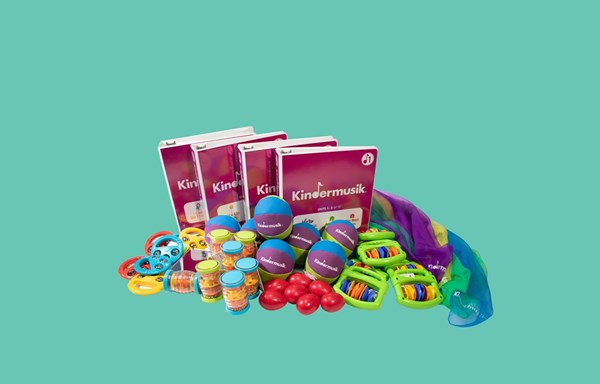
You can incorporate more repetition in your child’s life in some fairly simple ways.  One way is to set aside time each day for reading his or her favorite books together.  You’ll probably read his favorites repeatedly!  Another way to foster more repetition is to make full use of your Kindermusik home materials, enjoying the music and activities together regularly.

Try a few Kindermusik@Home activities for free today!

- Contributed by Theresa Case, whose Greenville, SC program, Kindermusik at Piano Central Studios, is proudly among the top 1% of Kindermusik programs worldwide.

Want to share this?
  • Facebook
  • Twitter
  • Google Bookmarks
  • RSS
  • Reddit
  • del.icio.us
  • Digg
  • LinkedIn
  • MySpace
  • Tumblr
Posted in Foundations of Learning | Tagged , , | Leave a comment

Spatial Skills Linked to Math Learning from Education Week

Repetition for child development

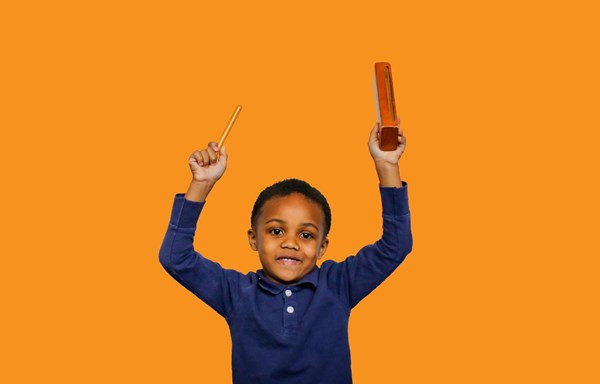
Learning how to hold a mallet!

This morning, Education Week published an article affirming spatial skills as a key to math learning. Movement and “task” activities (cutting paper shapes, building blocks, coloring in lines, clapping, stomping, singing) not only improve a child’s discipline ability to write neatly, they improve his or her capacity for abstract reasoning. The article quotes Claire E. Cameron, research scientist at the University of Virginia’s Center for Advanced Study of Teaching and Learning, on this point:

“We think of early-childhood classrooms as being really high in executive-function demands, but what children are being asked to exercise [executive function] on end up being visual-motor and fine-motor tasks.”

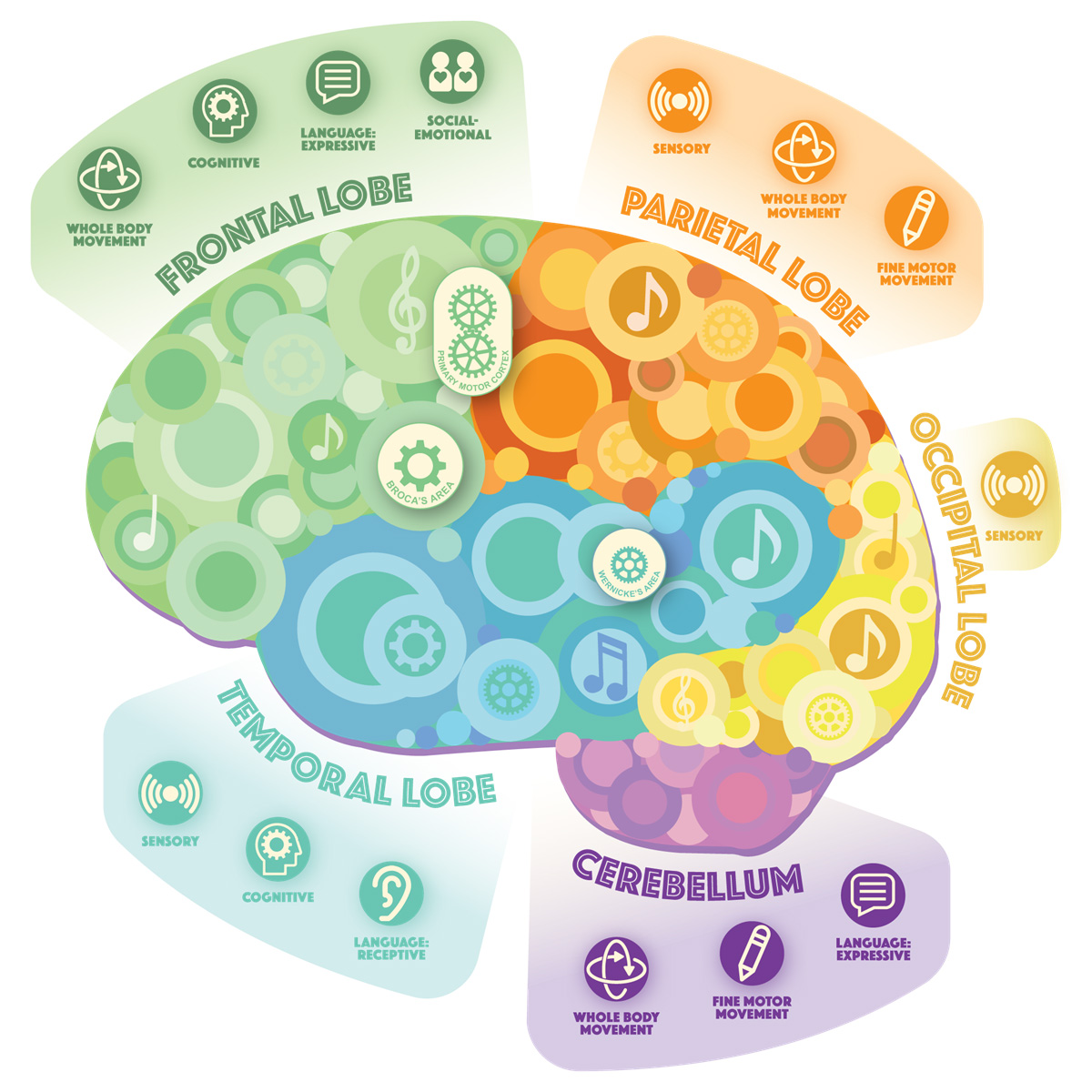
Here’s how it works. As you listen to music or make music, certain neuronsin the cortex of your brain start firing. The pathways created are the same pathwaysthat are used when you complete complex spatial reasoning tasks. The more of these pathways that are forged and the more they are in use, the stronger the connections become. Strong connections lead to easier access, which translatesinto better skills.

Although listening to music does give the neural network a workout, the gains in spatial
reasoning skills have been shown to be very short-term—15 minutes or less. This “Mozart
effect” is much longer-lasting when you engage in making music, however. Studies are showing that the attendant spatial reasoning gains can extend over months or even years (Rauscher et al, 1997; Gardiner, 2000; Hetland, 2000b). Studies focused on music for young children are also suggesting that math gains increase according to the number of years that students engage in active music learning (Gardiner, 2000), with some indication that the younger children are when they begin music instruction, the greater the gains will be.

Read more from Kindermusik about the benefits of music and math here, and comment below with questions or feedback!

Want to share this?
  • Facebook
  • Twitter
  • Google Bookmarks
  • RSS
  • Reddit
  • del.icio.us
  • Digg
  • LinkedIn
  • MySpace
  • Tumblr
Posted in Benefits of Music | Leave a comment

Oh Mother!

Photo Credit: latinohealthzone.com

As an early tribute to Mothers Day, we’d like to share some thoughts on the indefatigable job of – you guessed it – being a mom.

Mothers live an interesting paradox: they are either recognized as saints or servants. A child is a mother’s most important responsibility, and consequently, motherhood is celebrated culturally around the world. Mothers are emblems of caring, giving, patience, and love.

Of course – there’s more to a mother’s saintliness than meets the eye. Is there a biological reason for a mother’s celebrated traits? In this article, Bill Muehlenberg comments on a mother’s dual role in guiding her child both spiritually and practically. He reminds us of Ann Crittenden’s poignant description of this double responsibility. On one hand, Crittenden points to the Jewish adage, which says, “God could not be everywhere, and therefore He made mothers.” On the other hand, there’s the Arab adage, which says, “the mother is a school; if she is well reared, you are sure to build a nation”.

The Arab adage resonates with Kindermusik’s key principle that the parent is the child’s best teacher. In biology, the body is considered to stop physically optimizing once a mother has passed her child-bearing years – evolution is a hard-hearted process of competition, survival of the fittest, and passing genes from one generation to the next. But after a woman has finished having children, another fascinating evolutionary trait sets in: caretaking.

A fascinating Radiolab podcast, “The Good Show,” illuminates this paradox. If altruism (motherhood!) is the opposite of survival of the fittest, how do we explain (as Radiolab puts it) “why one creature might stick its neck out for another?” Why do mothers spend a lifetime “sacrificing” themselves for their children?

The answer, according to “The Good Show,” is still genetic (hence not “purely altruistic”) – a mother is protecting her genes by protecting her child. Even if the show decides that pure altruism doesn’t exist, a mother’s lifelong task of raising her child (to protect her genes) is the most influential force in a child’s development. Maybe we can all agree that being a mother can feel like a selfless plight of altruism, but in the end, the giving, caring, music classes and teaching! – really, really, pays off. What do you think? Comment below!

Happy Mothers Day!

Want to share this?
  • Facebook
  • Twitter
  • Google Bookmarks
  • RSS
  • Reddit
  • del.icio.us
  • Digg
  • LinkedIn
  • MySpace
  • Tumblr
Posted in Kindermusik | Tagged , , | Leave a comment

In Venezuela, Classical Music Fights Poverty

Photo Credit: La Prisma (theprisma.co.uk)

Is music literally capable of saving lives? According to Dr. José Antonio Abreu, it definitely is. His story is a reason to celebrate this Monday morning, and a powerful reminder of the power of music for children.

In 1975, Dr. Abreu, a Venezuelan economist and musician, founded El Sistema, ”The System,” a classical music youth training program for children in some of the poorest Venezuelan communities. Now publicly funded with branches in the United States, United Kingdom, and Portugal, El Sistema helps Venezuela’s 125th youth orchestras with training, funding, and the ability to travel worldwide to perform some of the highest level youth classical music in the world.

Why use music as the mechanism for social change? When asked about his vision for El Sistema, Dr. Abreu said:

Music has to be recognized as an agent of social development, in the highest sense because it transmits the highest values – solidarity, harmony, mutual compassion. And it has the ability to unite an entire community, and to express sublime feelings.”

Seventy to ninety percent of the children who participate in the program come from the poorest neighborhoods in Venezuela– like Sevilla, a slum in Caracas. Abreu’s success in navigating the program through thirty-eight years of political turmoil is testament to his determination and conviction about the power of music for children. Watch the 60 seconds video here, or watch the clip below!

Want to share this?
  • Facebook
  • Twitter
  • Google Bookmarks
  • RSS
  • Reddit
  • del.icio.us
  • Digg
  • LinkedIn
  • MySpace
  • Tumblr
Posted in Benefits of Music | Leave a comment

FOL Fridays: Becoming a Good Listener

Focusing on one sense at a time helps children strengthen their perception.  Focusing on sound, for example, sharpens listening skills.  Experts say that about two-thirds of everything learned is learned through listening.  When children are given an opportunity to practice their listening skills, they also enhance their abilities to focus and pay attention, allowing them to understand and interpret more of what they hear.

Ideas for parents:

As you take a walk outdoors with your child, encourage your child to listen, identify, imitate, and discuss the different sounds you hear.  Listen for the sound of birds, neighbors chatting, lawn mowers, vehicles, and more.  You’ll have a lot of fun playing the “Listening Game,” and your child’s listening skills will be sharpened too!

Try a Free Kindermusik Class!

We engage kids in fun activities every week in Kindermusik music classes for kids – and focus on developing listening skills, cognitive skills, musical skills and more. Learning through music and movement is fun and effective, come check it out.

- Contributed by Theresa Case, whose Greenville, SC program, Kindermusik at Piano Central Studios, is proudly among the top 1% of Kindermusik programs worldwide.

Want to share this?
  • Facebook
  • Twitter
  • Google Bookmarks
  • RSS
  • Reddit
  • del.icio.us
  • Digg
  • LinkedIn
  • MySpace
  • Tumblr
Posted in Foundations of Learning | Tagged , | Leave a comment